As soon as the medium of video games could move beyond the early tic-tac-toe and checkers simulations built in laboratories and schools, we became obsessed with the thrill of action. Dogfights between spaceships, tank battles, abstractions of ping-pong - universal, simple ways to place a player in a dramatic conflict. Quantify the action with mechanical systems to measure success and failure, and new needs arise: enemy patterns, collision, health.
Health in games is often portrayed as a binary rather than a gradient, where wounds suffered by the player do not impede their abilities; an injured adventurer can swing an axe as well as a healthy one, even when they are only a goblin's touch away from death. Interplay between the ideas of health and ableness are, unsurprisingly, rare. No one is very interested in controlling a swordfighter that swings more exhaustedly the longer his fights go on, and the industry at large seems to have accepted this concession from reality.
Studying how these ideas track in gameplay systems allows us to paint a greater picture of developers' intent regarding forgiveness and challenge. Nintendo's Super Mario series, specifically, has a long history of experimenting with these ideas across many decades, and thus gives us a unique insight into how player expectations (and expectations of players) have changed.
Quick summary! Super Mario Bros. (1985) codified the idea of a powerup for the series: an item acquired during gameplay that both increases Mario's survivability and abilities. With the exception of timed powerups like Starman or the Hammer from Donkey Kong (1981), powerups are usually retained as long as the player is able to avoid damage.
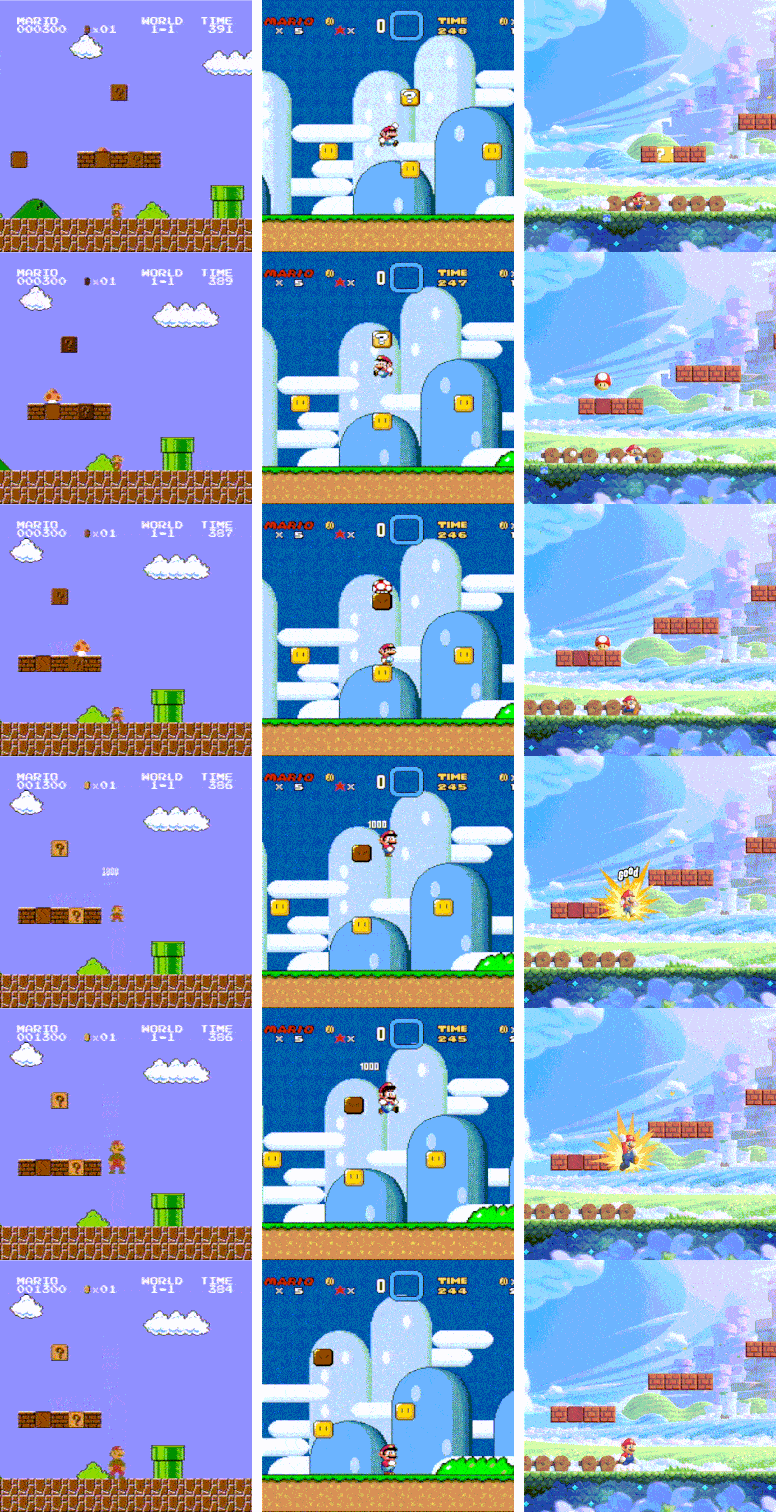
Another general rule is that powerups visually transform Mario, be it a costume, accessories, or a new color palette. These designs keep things cartoony and whimsical (powerups are explicitly magical, per the original instruction manuals), but also conveniently keep the player's collider boundaries standardized. It's a reward to see Mario put on a funny hat or transform into an animal (bless the designers that have to come up with a fresh set every few years). The greater effect of all this is to characterize the Mushroom Kingdom as a sort of magical playground - one where it's okay to laugh along while adventuring. Charms aside, Mario is a series ultimately about verbs, not adjectives, and while powerups serve well as tonesetters, their greatest usage is in utility.
My interest with the powerup system lies with its ability to recontextualize the play space around Mario himself. Powerups often grant abilities with tremendous interplay between mobility, combat, and exploration, which encourage the player to notice otherwise-unseen details and create moments of situational risk and reward.
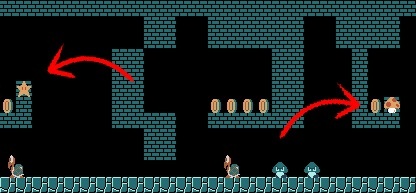
As early as World 1-2 of SMB, Nintendo had realized the potential for secret-hiding via powerup abilities, where several blocks can only be interacted with while powered up.
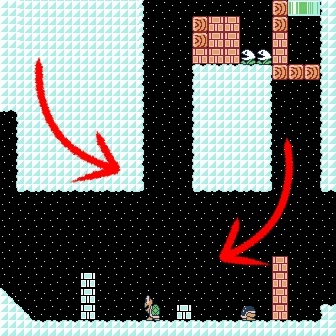
This concept was explored further in courses like World 6-5 of Super Mario Bros. 3 (1989), where the vertical shaft leading to the exit cannot be traversed without a flight powerup. The course features a looping pipe section which resets its blocks, which prevents a softlock as long as time remains on the clock.
Another option is to create environments where clumsy powerup usage can endanger the player. There's an effort to have a good-natured humor in these kinds of traps, where the player becomes ensnared in hazards of their own making.
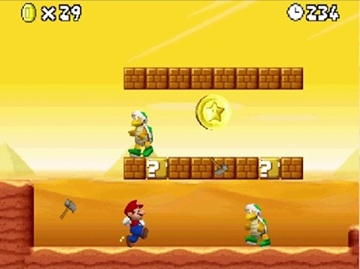
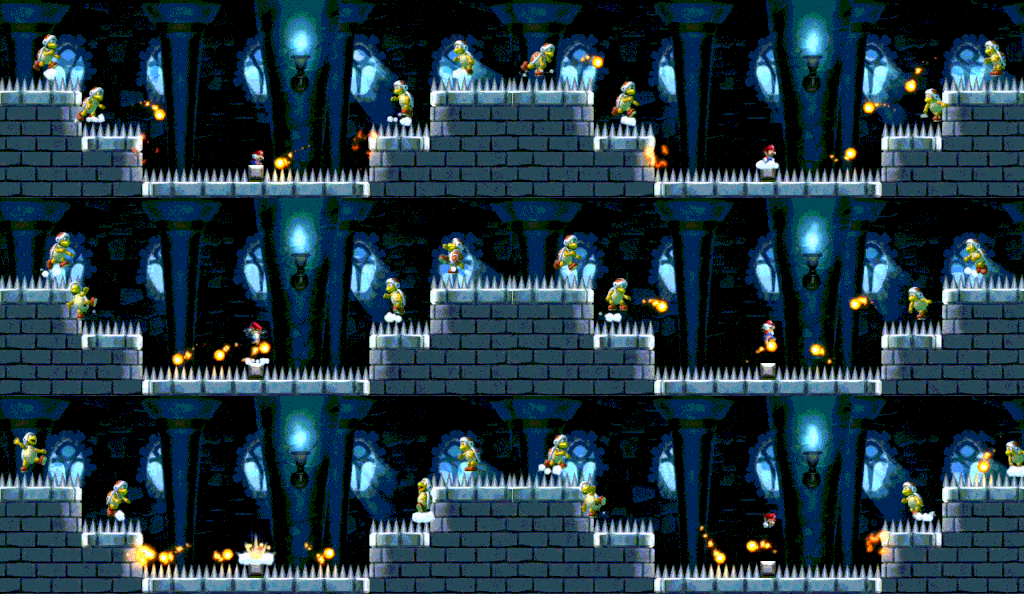
In World 2-4 of New Super Mario Bros. (2006), the player has the option of breaking the blocks that the Hammer Bros. are pacing on. This could create an opening to climb over the Bros., but risks dropping a Bro on their head from above.
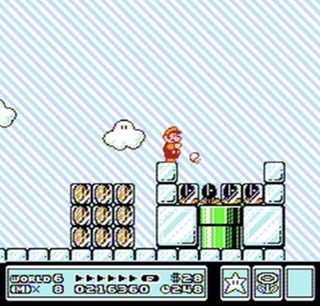
Another example is World 6-10 of SMB3, where using a Fire Flower to unfreeze the coins encased in ice can also release sealed Munchers. (Note that the button to make Mario run is the same as the button to throw a fireball, further increasing the danger of speedy play.)
"Take risks to get rewards. This push and pull is the very core of game essence. It also has a big impact on what we call 'strategy.' Strategy is all about using ingenuity to reduce risks and get rewards. Risk and reward must be in close proximity, and in the right amounts. Always look for exciting ways to link the two and add twists." - Masahiro Sakurai
SMB established another caveat: taking damage removes powerups, resetting Mario to Small Mario status. (Note that this happened even while powered up as Fire Mario.)
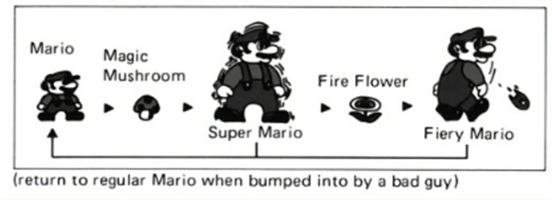
This contributed to the toughness of early Mario games: powerups were scarce and mistakes removed them promptly. The games have flip-flopped on the rules as they continued to experiment, but have since settled on more forgiving gameplay: players only descend one powerup tier at a time.
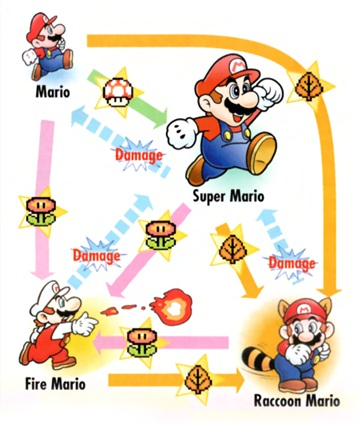
Later entries also relieved the pressure by expanding Mario's optional moveset: carrying and kicking Koopa Shells, Spin Jumps, Ground Pounds, Wall Jumps, etc., which makes Small Mario not nearly as helpless a state as before. Two points should be emphasized here: one, that Nintendo has created a system where Mario's core physical limits are reliable and predictable regardless of powerup status (imagine a version of the games where the jumps could be made unclearable without powerups?), and two: that every Mario course can be cleared with the basic moveset.
Given that Mario serves as one of Nintendo's most friendly-to-newcomers franchises nowadays, all these things serve to both give less experienced players a fighting chance regardless of powerups, and also give series veterans a greater range of expression and a higher skill ceiling to master. That being said, these games are usually more fun with powerups. How do we get them?
SMB3 and SMW introduced three major changes to powerup accessibilty: the World Map, the Inventory, and the Stored Item. The World Map displays the individual levels as part of a larger area, the Inventory allows for players to hold powerups for later assignment through minigames and interactions on the world map, and the Stored Item allows for in-level usage of a second powerup, either automatically dispensing when the player was injured, or manually via a button press.
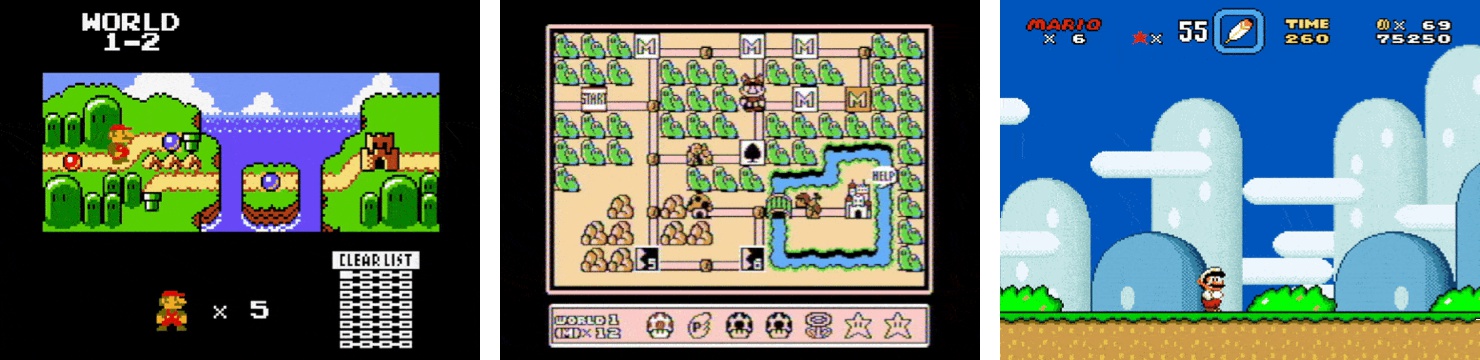
The SMB3 World Map encourages players to consider a course in relation to its greater setting. It's a cute bit of strategy that synergizes well with the game's Inventory. Suppose the player discovers a Toad House and collects a powerup. Will they use it now and risk coming across a secret that requires something else? What if this is the only one in this stretch of courses? What if the level is especially difficult and Mario takes damage?
(Sidenote: powerups that exist within a course and ones that are collected on the World Map technically are separate. If we were to be precise with our language, activating a powerup from the Inventory merely grants that powerup upon entering a course. By making the collection and usage of powerups one-way, Nintendo prevents players from, say, running through a course with five Fire Flowers in it and collecting all five for their inventory.)
The World Map from SMW onward, however, is even more forgiving. Players now can visit old courses, pick up specific powerups not available anywhere else, and bring them into new ones via the Stored Item. Whereas previously collecting a powerup while fully powered up did nothing (except grant points), now it serves as a future investment as a reward for skilled play, much like Super Metroid's Reserve Tank and Mega Man X's Sub Tank.
One could argue all of this is part of a greater discussion to answer the question, "How do you make a game where the player has one hit point beginner-friendly?" Needless to say, Nintendo is sympathetic to all skill levels, and generally tries to accomodate whenever they raise the skill floor over the course of a Mario game. For example, when the final boss battle with Bowser was made into a multi-phase sequence in SMW, Nintendo also included Princess Peach to toss Super Mushrooms into the arena during the intermissions.
In a series like Mario where the verbs for combat and exploration are the same, powerups create multiple points of interest: replay value, secret-collecting, and difficulty modification. Furthermore, everything within this ecosystem of values has ripple effects - gain the ability to fly to avoid fighting an enemy that's been giving you trouble, and open up new routes through the level as a result. All in service to the greater curiosity and delight of the experience - everything is connected!
Some powerups can trivialize the challenge of a given level (or in the case of items like SMB3's P-Wings, are designed to do so). Nintendo, however, doesn't worry about players abusing this - instead banking on the fact that actually playing the game is more fun than skipping over it. If your abilities don't do exciting things, the player won't be excited to collect them.
Lest we forget, everything discussed here could have been pips on a health meter. By choosing to create a ruleset where the entire state of gameplay hinges around the player's health, Nintendo created systems where every hit matters.
"A good idea is something that does not solve just one single problem, but rather can solve multiple problems at once. It's easy for people to come up with a good idea that can focus on one problem, but that's not good enough." - Shigeru Miyamoto